Why would there be a bottle of wine on the stove?!
WTF Barbie you can’t use a cutting board for a bulletin board
BARBIE! you should know better than to leave a cheese grater on the edge of the fridge! someone could get hurt!
Um, okay, DOES NO ONE REALIZE THAT BARBIE is cleaning her kitchen floor with a garden hose? Get it together, Barbie.
OH MY GOD BARBIE! ARE YOU JUST GOING TO LEAVE THOSE DIRTY DISHES IN YOUR SINK? SERIOUSLY GET IT TOGETHER BARBIE!
…Seriously?
People. Wow. Open your EYES.
Is NOBODY going to point out how Barbie is CLEANING HER FLOOR
IN
WHITE
PANTS???
CLOSE THE DAMN REFRIGERATOR! YOUR LETTING ALL THGE COLD OUT!
Barbie, seriously? The blender on top of the fridge? You could get hurt!!1
Guys for the love of god how can you not notice the freaking rat next to the fridge?! WTF Barbie? Clean your house more often, would ya?
Barbie, who the hell puts a calculator on their fridge. COME ON! GET WITH THE TIMES!
I love how everyone pretends not to notice the toaster next to the sink. BARBIE! YOU COULD GET ELECTROCUTED IF THAT FELL IN! GET YOUR SHIT TOGETHER GURL!
what the hell is wrong with you people???!?!?!
omfg how can you not notice the fact the fridge has three layers of drawers on the bottom? what the fuck?? barbie fridges dont work that way im sorry
SERIOUSLY?!! YOU PEOPLE ARE SICK! CAN YOU SEE THAT A SERIOUS CRIME HAS BEEN COMMITTED HERE?!!
THAT WALLPAPER! IT’S HIDEOUS! Get a freakin’ sense of style, woman!
theres a dead body
OMG why does she not put the bread away. She should put it in the pantry so she could have more room on the counter.
ITS THE ORIGINAL POST IVE ONLY SEEN SCREENSHOTS
BARBIE YOUR TOWEL IS PRACTICALLY ON THE FLOOR ITS WAY TOO LOW
Seriously Barbie? You try and open the oven and the towel ends up on the floor.
Ffs, that garlic isn’t going to keep above the stove like that. If you want dried up garlic just buy the powder.
The average active adult needs 2,000 calories per day in order to function in a safe and healthy manner. If I’m active to the point where I consistently run 1+ hour every day, then it is far more likely that my caloric needs are around 2,400-2,500.
Considering that, a meal of 1,200 calories would perfectly suit my needs. It would supply roughly half of my calorie requirements, which is a God-send since a fast food meal is relatively cheap. It’s a great value, especially if I don’t have much time to cook or have the resources to prepare my own meals!
The average burger is going to supply me with significant protein and carbs. That’s exactly what I’d need in order to build more muscle and have enough energy to make it through a workout. Even the sugar within the meal can be beneficial in supplying me with a boost of energy and can stop me from feeling hungry for a prolonged period of time. Not half bad.
Is this the most healthy meal known to man? Of course not. But it’s still a very reasonable deal and the calorie count is well within the average adult’s daily needs.
Don’t let calories scare you! You need them. If you were capable of burning off an entire meal within the hour, you’d probably be dead by now.
1200 empty calories in a meal
next to no nutrition. all the calories are sugar and fat. that’s it. you’ll have no energy and have glucose spikes in your blood because the lack of fiber because of the lack of complex carbs. this is diabetes in a meal.
so no, you should not be hungry for diabetes
Nutritionally, this BK meal contains roughly 28g of protein and 3g of dietary fiber. It potentiallyalso includes 35% of our Vitamin C daily requirements, 2% Vitamin A, 12% calcium, and 27% iron. Of the 1,010 calories (that I could verify directly from the company’s nutritional information guide), only 410 are from fat. That isn’t a terribly significant amount of fat, in the long run, nor are the nutrients small enough to be viewed as negligible.
Eating this will not cause you to get diabetes. Eating this meal is perfectly fine if you do have diabetes, as long as you are able to adjust your insulin intake accordingly. So don’t use an illness as your debate point – Diabetic people are not a prop.
“So don’t use an illness as your debate point – Diabetic people are not a prop.” I want that and variations of that on t shirts.
damn, man. Someone just got completely schooled by a nutritionist.
THIS A GOOD POST
I’ve reblogged this again but I feel like it needs to be SAID again. Also someone needs to please come drive me to burger king and buy me a burger. Pretty please?
This weekend I was schmoozing at an event when some guy asked me what kind of history I study. I said “I’m currently researching the role of gender in Jewish emigration out of the Third Reich,” and he replied “oh you just threw gender in there for fun, huh?” and shot me what he clearly thought to be a charming smile.
The reality is that most of our understandings of history revolve around what men were doing. But by paying attention to the other half of humanity our understanding of history can be radically altered.
For example, with Jewish emigration out of the Third Reich it is just kind of assumed that it was a decision made by a man, and the rest of his family just followed him out of danger. But that is completely inaccurate. Women, constrained to the private social sphere to varying extents, were the first to notice the rise in social anti-Semitism in the beginning of Hitler’s rule. They were the ones to notice their friends pulling away and their social networks coming apart. They were the first to sense the danger.
German Jewish men tended to work in industries which were historically heavily Jewish, thus keeping them from directly experiencing this “social death.” These women would warn their husbands and urge them to begin the emigration process, and often their husbands would overlook or undervalue their concerns (“you’re just being hysterical” etc). After the Nuremberg Laws were passed, and after even more so after Kristallnacht, it fell to women to free their husbands from concentration camps, to run businesses, and to wade through the emigration process.
The fact that the Nazis initially focused their efforts on Jewish men meant that it fell to Jewish women to take charge of the family and plan their escape. In one case, a woman had her husband freed from a camp (to do so, she had to present emigration papers which were not easy to procure), and casually informed him that she had arranged their transport to Shanghai. Her husband—so traumatized from the camp—made no argument. Just by looking at what women were doing, our understanding of this era of Jewish history is changed.
I have read an article arguing that the Renaissance only existed for men, and that women did not undergo this cultural change. The writings of female loyalists in the American Revolutionary period add much needed nuance to our understanding of this period. The character of Jewish liberalism in the first half of the twentieth century is a direct result of the education and socialization of Jewish women. I can give you more examples, but I think you get the point.
So, you wanna understand history? Then you gotta remember the ladies (and not just the privileged ones).
Holy fuck. I was raised Jewish— with female Rabbis, even!— and I did not hear about any of this. Gender studies are important.
“so you just threw gender in there for fun” ffs i hope you poured his drink down his pants
I actually studied this in one of my classes last semester. It was beyond fascinating.
There was one woman who begged her husband for months to leave Germany. When he refused to listen to her, she refused to get into bed with him at night, instead kneeling down in front of him and begging him to listen to her, or if he wouldn’t listen to her, to at least tell her who he would listen to. He gave her the name of a close, trusted male friend. She went and found that friend, convinced him of the need to get the hell out of Europe, and then brought him home. Thankfully, her husband finally saw sense and moved their family to Palestine.
Another woman had a bit more control over her own situation (she was a lawyer). She had read Mein Kampf when it was first published and saw the writing on the wall. She asked her husband to leave Europe, but he didn’t want to leave his (very good) job and told her that he had faith in his countrymen not to allow an evil man to have his way. She sent their children to a boarding school in England, but stayed in Germany by her husband’s side. Once it was clear that if they stayed in Germany they were going to die, he fled to France but was quickly captured and killed. His wife, however, joined the French Resistance and was active for over a year before being captured and sent to Auschwitz.
(This is probably my favorite of these stories) The third story is about a young woman who saved her fiance and his father after Kristallnacht. She was at home when the soldiers came, but her fiance was working late in his shop. Worried for him, she snuck out (in the middle of all the chaos) to make sure he was alright. She found him cowering (quite understandably) in the back of his shop and then dragged him out, hoping to escape the violence. Unfortunately, they were stopped and he, along with hundreds of other men, was taken to a concentration camp. She was eventually told that she would have to go to the camp in person to free him, and so she did. Unfortunately, the only way she could get there was on a bus that was filled with SS men; she spent the entire trip smiling and flirting with them so that they would never suspect that she wasn’t supposed to be there. When she got to the camp, she convinced whoever was in charge to release her fiance. She then took him to another camp and managed to get her father-in-law to be released. Her father-in-law was a rabbi, so she grabbed a couple or witnesses and made him perform their marriage ceremony right then and there so that it would be easier for her to get her now-husband out of the country, which she did withing a few months. This woman was so bad ass that not only was her story passed around resistance circles, even the SS men told it to each other and honoured her courage.
The moral of these stories is that men tend to trust their governments to take care of them because they always have; women know that our governments will screw us over because they always have.
Another interesting tidbit is that there is sufficient evidence to suggest that Kristallnacht is a term that historians came up with after the fact, and was not what the event was actually called at the time. It’s likely that the event was actually called was (I’m sorry that I can’t remember the German word for it but it translates to) night of the feathers, because that, instead of broken glass, is the image that stuck in people’s minds because the soldiers also went into people’s homes and destroyed their bedding, throwing the feathers from pillows and blankets into the air. What does it say that in our history we have taken away the focus of the event from the more domestic, traditionally feminine, realms, and placed it in the business, traditionally masculine, realms?
Badass women and interesting commentary. Though I would argue that “Night of Broken Glass" includes both the personal and the private spheres. It was called Kristallnacht by the Nazis, which led to Jewish survivors referring to it as the November Pogrom until the term “Kristallnacht" was reclaimed, as such.
None of this runs directly counter to your fascinating commentary, though.
READ THIS.
“
The moral of these stories is that men tend to trust their governments to take care of them because they always have; women know that our governments will screw us over because they always have.
So recently, I got calls from the phone number, (937) 353-8319. They claim to be a job service, and one of their “employees”, Carrigan, is friends with whoever the call recipient is, and that Carrigan has recommended you for this $15.00/h “job”. I also got a text message from (937) 607-1493, claiming to be Carrigan, and that they need stuff to “win a scholarship”. I do not know anyone by the name of Carrigan and I know very well that this is a very dangerous scam.
If you receive a call from a number, and they ask you if you would like a job for $15.00/h, HANG UP IMMEDIATELY. If you accept the “job” offer, and you go in for an interview, they will give you a drugged bottle of water and you will wake up somewhere you don’t want to be.
These phone calls & texts are from a human trafficking service, and if you oblige to them, you will be sold to people and you will be raped, no doubt about it. So PLEASE PLEASE DO NOT ANSWER THESE CALLS OR TEXTS. I have listened to the voicemails, and allowed my dad to do the same, and he learned that anyone offering a $15.00/h “job” is a human trafficker.
PLEASE SIGNAL BOOST THIS ALL OVER TUMBLR
Okay, I am reblogging this because it is relevant again. I got another call from a 353 number. Not the exact same number, but I know that it is a trafficker because it’s 353 just like the last one. I also want this to signal boost so PLEASE REBLOG THIS.
Why are people deleting the captions though I had to search for what the pictures meant don’t do that
a side note, because theyre very popular around the DMV, If you ever see a sign with something akin to ‘free debt erasure’ ‘15/h job’ etc and ONLY A PHONE NUMBER, ignore it. tear it down if you can, because those are well known scams and sex-trafficking baits.do not, by any means, call or respond to these messages. do not let your friends do it. do not.
THIS IS IMPORTANT AF THANK Y’ALL HOLY SHIT
Oklahoma is one of the worst states as far as human trafficking, so thank y’all so fucking much. That’s literally my life and the lives of everyone I know that y’all just saved. Thank you. Thank you thank you thank you
*FUCKING SPAMS REBLOG*
guys pls this needs more reblogs
Please be safe guys
Tumblr is keeping my dumbass safe. And my mom says im never gonna learn anything with my eye always on my phone. 😂👌🏾
This is just a reminder that although our Kickstarter has completed, you can still get a registration key to join the site on September 1st if you donate $5 or more to our PayPal!
We’ve also made the decision to keep PayPal donations for keys open indefinitely– so we’re basically just extending the offer of the Kickstarter. So if you want to wait a bit and see how other people like the site before you join, you’ll be able to donate to the PayPal and get a registration key even after the September 1st date. After September 1st we’ll send out registration keys on a weekly basis every Friday (so for example if you decide to donate for a key on September 2nd you’ll get it on Friday the 7th). Doing this will help keep the site’s population from stagnating, and will also provide us with additional funding for our expenses and developer payroll while we’re still working on putting the site’s paid features system in place. Once we have paid features in place we will hopefully be able to start admitting free registrations again.
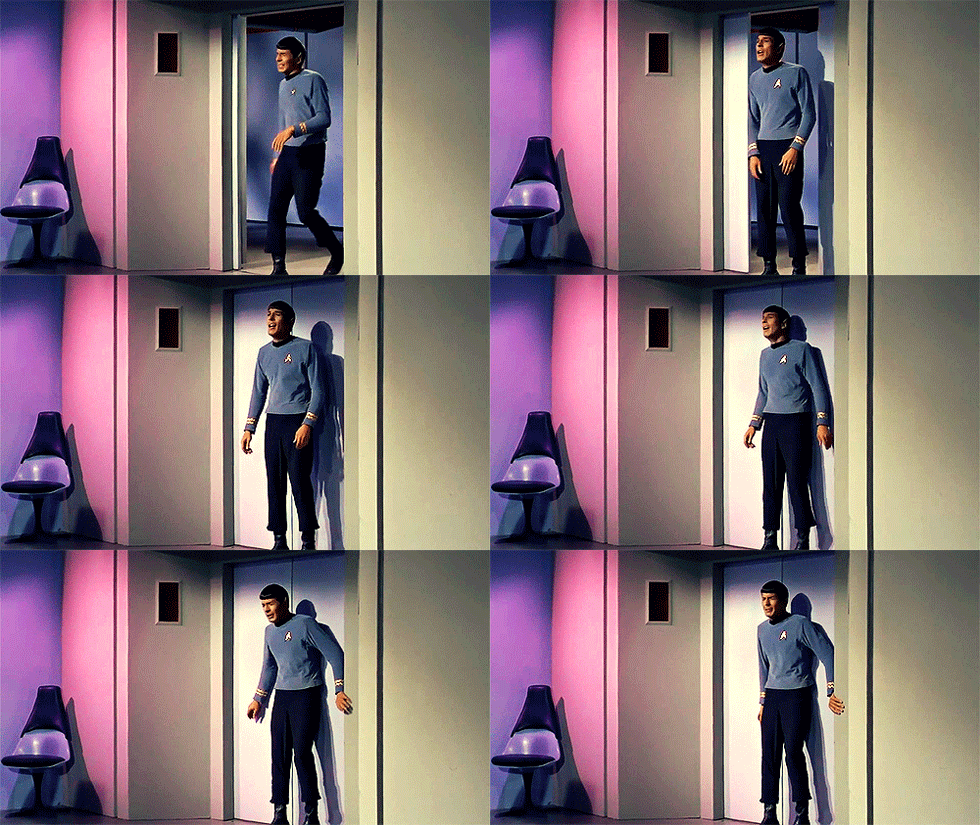
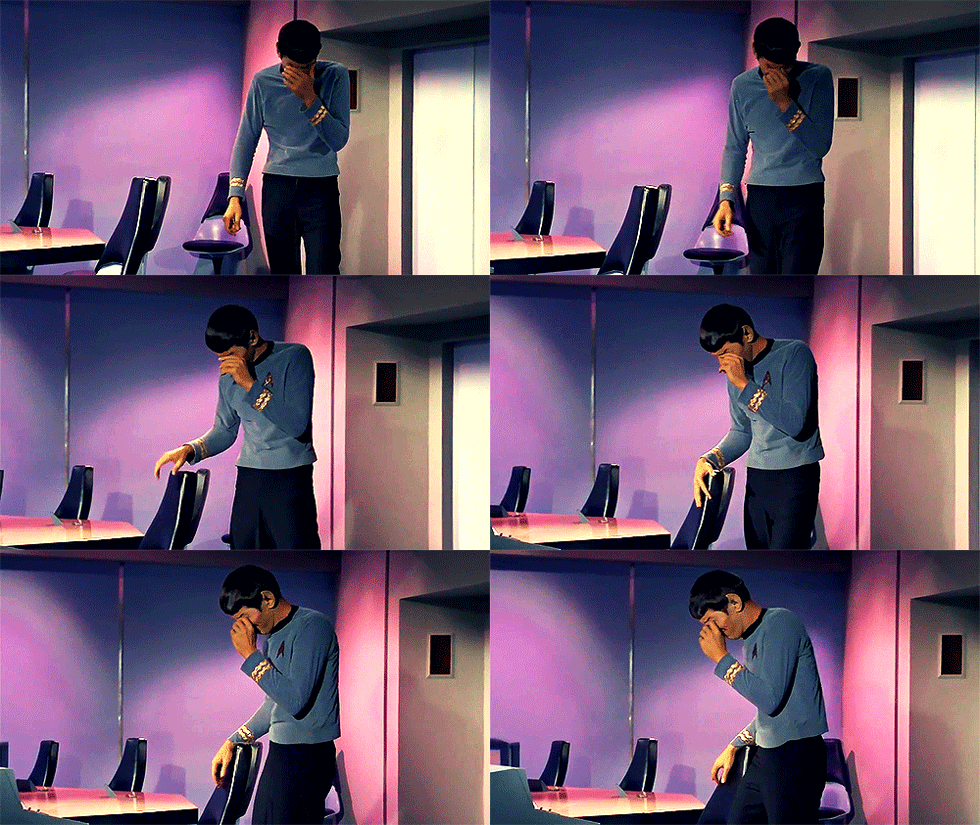
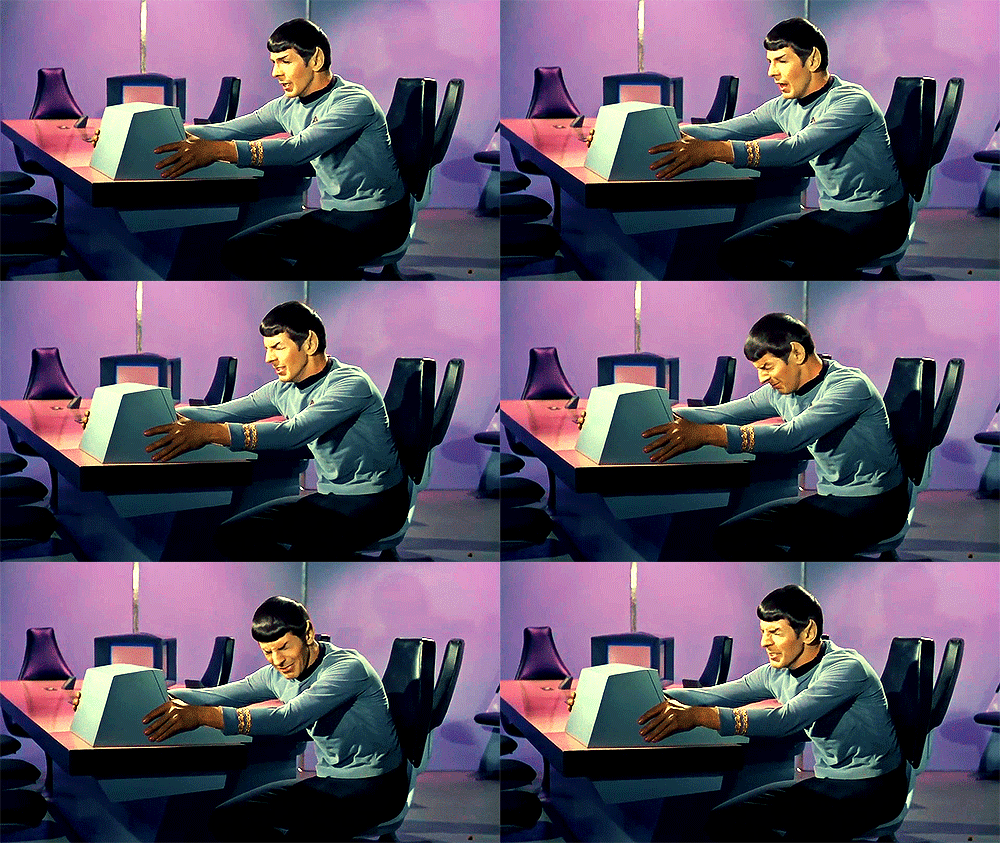
I’m gonna go ahead and be a film snob and talk about why this is one of my favorite shots from TOS. (I could also say that it’s one of my favorite scenes, because the entire scene actually consists of a single shot.)
We don’t see a lot of bald expressions of emotion in film and television, especially if that emotion is fear or sadness or vulnerability. Dramas will give us some tears, but they always cut a way after a few seconds because a closeup of someone crying is deeply uncomfortable and most movies and TV shows aren’t in the business of making their audiences uncomfortable. It just doesn’t sell well.
But in this scene the camera never looks away. It follows Spock as he sits down at the table, and it circles him as he cries. But there are no cuts. We don’t even get music to create some distance, make it all a little more palatable; we just hear sobs and mumbled math equations.
It’s absolutely excrutiating. It would be excruciating no matter who we were watching, because we are so unaccustomed to seeing unadulterated emotion. And then there’s the fact that it’s a man. And that it’s Spock.
Fifty years later and this is still one of the most daring filmmaking decisions I’ve ever seen on TV (I of course can’t be exactly sure who made it, but I’m assuming it was the director of the episode, Marc Daniels). This shot lasts 1 minute and 45 seconds. We’re in the middle of space and in the middle of a high-stakes episode where the crew is going crazy and the ship is going to blow up or some shit and everyone’s lives are in danger, but we pause 1 minute and 45 seconds to have an uncomfortably human moment with an alien who doesn’t even want to be human, and it’s so awful and amazing.
Here is an excerpt from Bill’s Star Trek Memories.
As originally scripted, the scene would have begun with Spock walking down a corridor openly sobbing. At that point, we’d cut away and find that another infected crewman has begun frantically running around the ship, slapping graffiti paint jobs all over the walls of the Enterprise. In subsequent shots, we’d find several more crewmen beginning to lose their inhibitions, and just when the pandemonium is beginning to overwhelm the ship, we’d come back to Spock.
Spock is now riding in an elevator, crying. He gets to his floor, and when the doors open, the graffiti guy runs up and paints a big black mustache on Spock’s face. At that point, Spock cries even louder. Leonard continues:
Now, that’s very imaginative, very inventive, very theatrical and very funny, but I felt that it was not really significant or appropriate for Spock. I mean, Spock was crying… but so what? There was no context for it, no discernible root force, no underlying cause for what’s going on. You know, in a strange way, this one-shot extra who’s walking around doing the paint jobs all over the place is a lot more interesting than Spock, who’s weeping. It seemed to me like we were wasting some really strong dramatic possibilities, all for the sake of an easy sight gag.
So I said all of this to John Black, and I also said that what I felt we really need to do her was a scene in which Spock’s basic inner conflict, the human versus the Vulcan, rises to the surface and motivates his tears. I mean this draft of the script found Spock fighting through all this emotion in public, and I felt that would be a terrible thing for Spock, because he’s a very private person.
So I said to John, “I think Spock would look for privacy when he feels the urge to cry. When he can no longer resist his tears, he would probably look for a private place in which to battle it out within himself.”
And John’s reaction was very negative. It was typical producer/writer-under-pressure kind of stuff. “C’mon, leave it alone because I’m working on next week’s script. Shoot it, just shoot it.” This kind of thing. And he complained about hurting the rhythm of the script.”
I’ve got to break into Leonard’s story here to explain that “it hurts the rhythm of the script” is a sort of basic, all-purpose producer’s excuse that’s fed all too often to actors seeking script changes. Good, bad, legitimate, frivolous, it doesn’t matter. If a producer doesn’t want to deal with your suggestions, he’ll probably just tell you that what you’re suggesting “hurts the rhythm of the script.” It’s the TV producer’s equivalent of “the dog ate my homework,” or “the check is in the mail.” It’s just an easy, somewhat plausible excuse that generally has no basis in reality. With that in mind, Leonard’s determination and fiercely protective nature in regard to Spock drove him over Black’s head to Roddenberry.
I called Gene about it, and I told him just what I’d told John. In talking to Gene, I was very careful to be politically supportive of his producer but about an hour and a half later, here comes John Black out to the set. So now I’m feeling, “Ahh, this great!” I’m feeling that someone’s actually listening to me.
And Black was funny, he cam onto the set and said, “Let’s go talk someplace.” We went to my dressing room, and he said, “Okay, tell me your idea again. Daddy says I have to listen to you.” And I had already formulated a basic concept of the scene, so I said, “Look, John, just get me into a room, and write me a half-page, a quarter-page, where you see Spock walk down a corridor and slip inside a door. As the doors close behind him, he’ll burst into this emotional struggle.” And John asked, “Well, what’s this struggle all about?” And I said, “It’s about love and vulnerability and caring and loss and regret, versus C=pi-r-squared and E=m-C-squared. Spock is a scientist, he is logical, and he feels this can’t be happening to him. It’s that kind of struggle. It’s logic versus emotion. It’s rational control versus uncontrollable urge. With that in mind, going behind closed doors will speak to the basic privacy of the character.”
So John wrote that and some other stuff, six or eight lines maybe, and it was exactly what I needed. Spock was now able to slip inside a door, close it behind him, struggle for a moment, then cry. At this point, he would start babbling, and the cause of the internal struggling would become obvious. Problem was, when it came time to shoot this stuff, a whole new set of obstacles had to be overcome.
Marc Daniels, who was directing this particular episode, came up and asked, “What do you have in mind for this scene?” So, playing director, I said, “Just put the camera here, behind the desk. I’ll come in the door, I’ll walk toward you, I’ll come around, I’ll sit in the chair, and I’ll start this babbling conversation with myself, and I’ll cry. Now, if you’ll dolly around getting closer and closer we can meet at the end of the scene. We can see Spock’s entire breakdown in one long dramatic shot.”
Okay, now it’s five-thirty, I got out to get my ears and makeup touched up, and the time is important because we’re on a very rigid schedule. With overtime being so ridiculously and prohibitively expensive, we’d have to wrap each evening at exactly six-eighteen. Didn’t matter if you were in the middle of a sentence, come six-eighteen, we wrapped.
So now Jerry Finnerman starts to light the scene and it’s obvious that this will be our last shot of the day. I’m in the makeup chair, getting touched up, and now in comes Cliff Ralke, our dolly grip, who was always a very supportive person, and he says, “Excuse me, Leonard, but you’d better get out there, because they’re changing the shot you guys just talked about.”
So now Leonard comes out to the set, and the director has indeed changed the shot they’d just agreed upon. It’s important to note, however, that the reasoning behind this change, though not particularly sensitive to Leonard’s needs, was rational and perfectly valid. You see, as previously discussed, this shot would have entailed a one-hundred-and-eighty degree camera move starting from one side of the set, then slowly dollying completely around to the opposite end. This caused problems because the long, involved shot required a lot of lights and a time-consuming, involved setup that Jerry Finnerman didn’t think could be accomplished without going into overtime. Finnerman discussed this situation with Daniels, and together they decided that the most efficient way to shoot this scene would be in a series of brief cuts, each of which could be lit quickly and with relative ease.
They were going to have Leonard enter in a wide shot, then cut. Next, in a slightly tighter framing, they’d follow him as he crossed the set and sat down. Cut. An even tighter frame would catch the beginning of the speech, and they planned to cut once more, zooming to a close-up as Spock began weeping. This made sense in terms of production efficiency, but Leonard felt this shooting sequence would really damage the dramatic impact of the scene. He continues:
I said, “You’re going to lose the continuity and fluidity of the scene if you shoot it this way. I will not be able to do it as well, and I think the end result will just seem choppy and phony.”
By now it’s five forty-five, and with no time to debate the situation, they got hold Gregg Peters, our first A.D., who was the equivalent of the hatchet man. He was the guy who’d always call the six-eighteen wrap, and we all discussed the situation. Finally Marc Daniels said, “Let’s go for it. Let’s try to get it done.”
Now the lighting crew ran around setting up the shot, and I think it was about six-fifteen when they finally said, “We’re ready.” Marc had me walk through it once, and by now production types were standing around behind the camera, looking at their watches and saying, “He won’t make it. He’ll never do it.” So the tension was really mounting.
So basically I know this has got to be a flawless, one-take thing. Y’know, I’ve got one crack at it before they shut us down for the night. If I were to screw up, we’d almost certainly have gone right back to the cut-and-chop scenario come morning. Anyway, this was the scene that I’d asked for and fought for, and now the logistics of the situation were such that there was absolutely no room for error. There was a lot riding on this, and I wouldn’t have been so adamant in my battling if I hadn’t felt that this scene was extremely important. I felt like it merited my efforts, in that it truly defined, for the very first time, what the Spock character was all about.
Now the lights go on, the cameras roll and we nail it. They get the pan, get the one-hundred-and-eighty-degree dolly shot and the scene was ultimately worked really well in illustrating Spock’s inherent inner conflict. This went directly to the heart of what Gene and I had originally spoken about in regard to the character of Spock. It was an opportunity that I absolutely did not want to miss, and an opportunity to plant a seed in defining a certain edge of the character.
No, you don’t understand, you have to read this. Leonard Nimoy was amazing.




 Frankenuff’s Castle